
PPWR & Reusable Packaging: IoT Asset Tracking Guide

Our mission is to help businesses connect, protect, and derive more value from their assets. As a leading global innovator, developer, and supplier of IoT solutions, we drive continuous innovation to enable our partners to deploy confidently at scale worldwide.
Key Takeaways
- The EU Packaging and Packaging Waste Regulation, or PPWR, is increasing the focus on reusable packaging and reducing packaging waste across European supply chains.
- More reusable packaging means more pallets, crates, bins and containers need to move repeatedly between warehouses, customers, suppliers and distribution centres.
- That creates an asset visibility challenge. Businesses need to know where reusable assets are, how long they stay at each location and whether they are returning as expected.
- Digital Matter’s battery powered GPS tracking solutions can help businesses monitor reusable transport assets without relying on an external power source.
- GPS and Wi-Fi positioning can support asset visibility across outdoor and indoor environments as reusable packaging moves through the supply chain.
Packaging waste is a growing focus across Europe, with the EU Packaging and Packaging Waste Regulation, commonly known as PPWR, introducing new rules around packaging waste, recyclability and reuse.
For businesses operating across logistics, manufacturing, distribution and retail, one of the practical outcomes is simple: more packaging will need to remain in circulation and be reused. That includes transport packaging such as pallets, crates, containers, drums and bins moving between warehouses, suppliers, customers and distribution centres.
And once packaging becomes reusable, it also becomes something businesses need to manage.
What Is the PPWR?
The EU Packaging and Packaging Waste Regulation applies across the lifecycle of packaging and is designed to reduce packaging waste, improve recyclability and encourage greater reuse. The PPWR generally applies from 12 August 2026.
The regulation covers a broad range of packaging, but for businesses moving goods through supply chains, the growing emphasis on reusable transport packaging is particularly relevant.
The broader direction is clear: European businesses will increasingly need to consider how packaging can be returned, reused and kept in circulation rather than treated as single use.
For logistics and supply chain operators, that creates a very practical question: How do you keep track of reusable packaging once it leaves your facility?
Reusable Packaging Creates an Asset Management Challenge
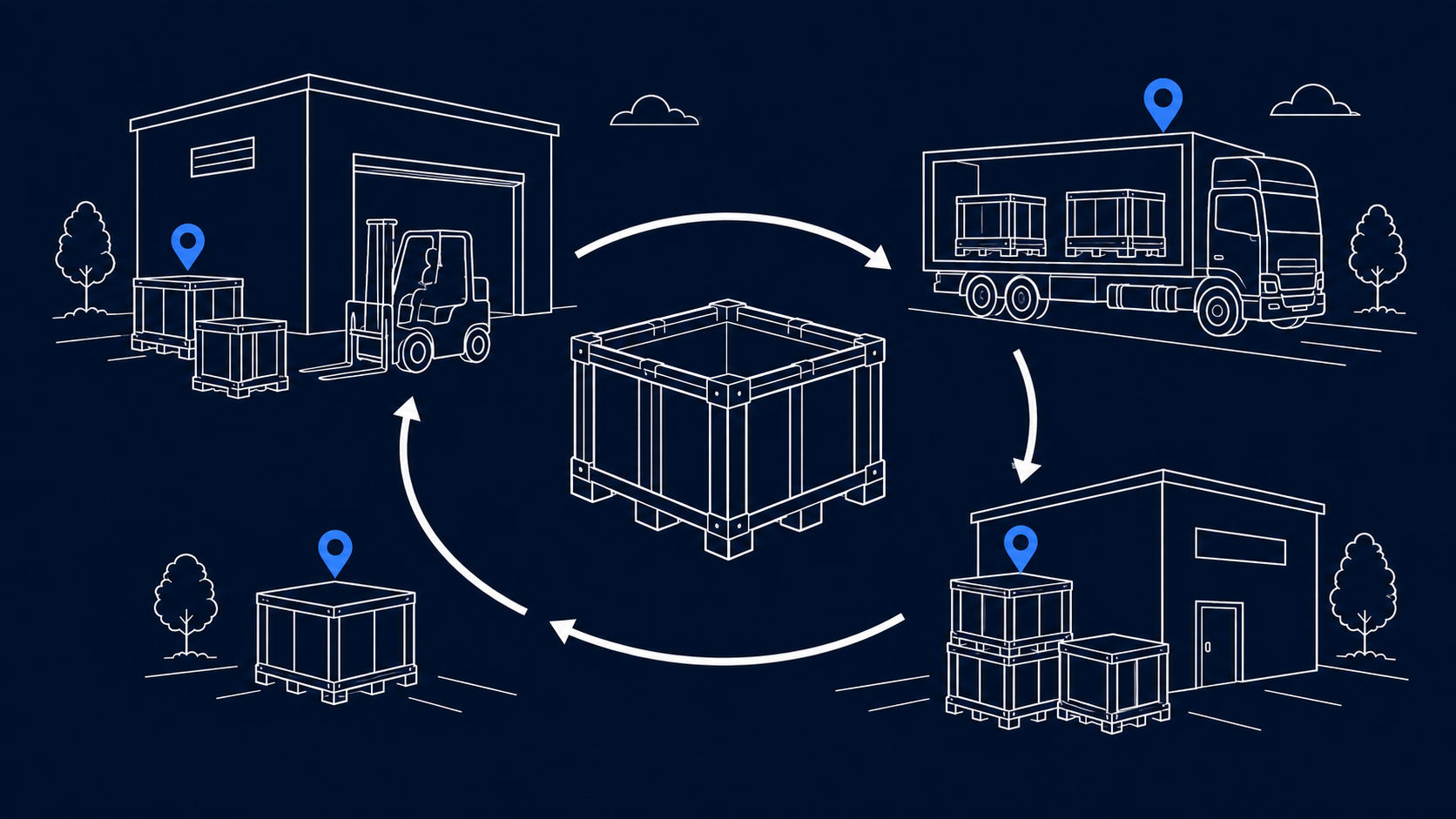
A disposable pallet, crate or container leaves the supply chain once. A reusable one needs to come back. That sounds simple, but returnable assets can move through complex networks involving warehouses, transport providers, customers, suppliers and third party logistics operators.
Once reusable packaging leaves a controlled facility, visibility can quickly disappear.
A pallet might sit at a customer location for weeks. A crate could end up at the wrong depot. A container may leave its intended network entirely. In other cases, assets are not necessarily lost, but nobody knows exactly where they are or when they are likely to return.
At small scale, businesses may be able to manage this manually. At larger scale, it becomes much harder.
If thousands of reusable assets are moving across dozens or hundreds of locations, even relatively small levels of loss or poor utilisation can create significant costs. Businesses may end up purchasing more pallets, crates or containers simply because they cannot locate the ones they already own.
This is where better asset visibility starts to matter.
Tracking Reusable Packaging and Transport Assets
Digital Matter provides battery powered GPS tracking solutions designed for assets that do not have their own permanent power source.
That makes our devices well suited to reusable transport assets such as pallets, crates, containers, bins and other equipment moving through the supply chain.
IoT tracking devices can provide location and movement data as reusable packaging travels between facilities, helping businesses understand where assets are, where they have been and how long they have remained at particular locations.
This can help answer practical questions such as:
- Where are our reusable assets right now?
- Which customers or facilities are holding them?
- How long are they spending at each location?
- Are they moving back through the network as expected?
- Where are assets regularly being lost or delayed?
- Do we actually need to purchase more assets, or could we improve utilisation of the ones already in circulation?
- Reusable assets need to be recovered.
- They need to be available when required.
- They need to spend less time sitting idle.
- And businesses need enough visibility to understand what is happening across their network.
That information can support better decisions around asset recovery, fleet sizing, utilisation and supply chain efficiency.
Battery-Powered GPS Tracking for Indoor and Outdoor Visibility
Reusable packaging can be difficult to track because the assets themselves often have no permanent power source. You cannot rely on a vehicle battery or fixed power connection to keep a tracking device operating.
Battery life therefore becomes a critical part of the solution.
Digital Matter devices are designed for long term, ‘deploy once’ applications on non-powered assets, using low power technology to reduce maintenance requirements and extend time in the field.
Depending on the application, Digital Matter solutions can combine GPS and Wi-Fi positioning to provide visibility across both outdoor and indoor environments.
GPS supports accurate outdoor location tracking, while Wi-Fi positioning can help locate reusable assets when they move inside warehouses, distribution centres and other facilities where GPS signals may be limited.
The right tracking approach depends on the asset, its value, how frequently it moves and the level of location detail required.
For some reusable packaging applications, direct cellular tracking may make sense. For very large fleets of lower value returnable assets, Bluetooth based approaches can help extend visibility across a greater number of assets while keeping deployment costs practical.
Does the PPWR Require GPS Tracking?
No. The PPWR does not require businesses to install GPS or IoT tracking devices on reusable packaging, and using Digital Matter hardware does not automatically make a business compliant with the regulation.
The connection is operational. As businesses increase the amount of reusable packaging within their supply chains, they also need effective ways to manage those assets.
A reusable packaging strategy becomes much harder to operate if pallets, crates or containers are regularly lost, delayed or sitting unused at unknown locations.
IoT tracking provides businesses with data that can help keep those assets moving and improve the performance of returnable asset pools. It can also help organisations better understand how reusable packaging is circulating across facilities, customers and supply chain partners.
Keeping Reusable Packaging in Circulation
The PPWR is one of several factors increasing the focus on reusable packaging across European supply chains. But making reusable packaging work in practice ultimately comes down to how effectively those assets are managed.
For companies increasing their use of reusable transport packaging, IoT asset tracking can provide that visibility.
Digital Matter’s battery powered tracking solutions help businesses monitor non powered assets across complex supply chains, providing the location and movement data needed to improve utilisation, reduce losses and keep reusable packaging in circulation for longer.

Shay Kettner - Head of Brand and Content
Shay Kettner is Head of Brand and Content at Digital Matter, with more than seven years of experience in IoT, GPS asset tracking, connected hardware, and technology marketing. She works closely with product, engineering, and commercial teams to translate complex technical concepts into clear, accurate content for business and industrial audiences. During her time at Digital Matter, Shay has contributed to the go to market strategy, positioning, and technical education of more than 40 IoT and asset tracking products deployed globally. Her areas of expertise include GPS tracking, IoT connectivity, battery powered asset tracking, remote monitoring, technical product education, and the adoption of IoT technologies across industries including logistics, agriculture, construction, fleet management, and industrial operations. Shay holds a Master of Commerce in Marketing with Distinction from Curtin University, where she was recognised as a top postgraduate student, and a Bachelor of Arts in Communication and Media Studies from Goucher College. Focus areas: IoT and asset tracking, GPS tracking technology, IoT connectivity, connected hardware, battery powered tracking, remote monitoring, technical product education, IoT market adoption and industry use cases.