
Our mission is to help businesses connect, protect, and derive more value from their assets. As a leading global innovator, developer, and supplier of IoT solutions, we drive continuous innovation to enable our partners to deploy confidently at scale worldwide.
.png)
A practical guide to devices, reporting behavior, and system design
The global trailer and cargo container tracking market was valued at approximately USD 3.6 billion in 2024 and is projected to reach around USD 7.8 billion by 2032, representing a compound annual growth rate of about 10.2%.
This growth is being driven by several clear forces:
- Rising demand for real-time asset visibility and transparency across supply chains
- Increased concern around theft prevention, insurance exposure, and regulatory pressure for fleet visibility and security
- The continued growth of e-commerce and the operational strain of last-mile delivery, which makes trailer tracking more practical and commercially valuable than ever
For fleet operators, logistics providers, and asset owners, a modern trailer tracker creates opportunities to improve utilisation, maintenance planning, theft response, and long-term cost control across valuable assets managed by distributed operations and internal team stakeholders.
Understanding how these systems actually work is the difference between a successful deployment and one that quietly underperforms.
What Is a GPS Trailer Tracking System?
A GPS trailer tracking system combines hardware, connectivity, and software to monitor the location and movement of non-powered assets such as trailers, containers, and dollies.
How GPS Trailer Tracking Differs From Vehicle Tracking
Vehicle tracking systems are designed for powered vehicles that move frequently and can support continuous reporting. Trailer systems must operate very differently because trailers:
- Often do not have a constant power source
- Remain stationary for long periods
- Move infrequently but sometimes unpredictably
Applying vehicle-style logic to trailers often reduces performance and battery life.
Trailers as Long-Dwell Assets
Trailers are best understood as long-dwell assets that spend most of their time parked at yards, customer sites, or roadside locations. Systems designed for this reality focus on exception detection rather than constant polling.
Core Components of a Trailer Tracking System
Every commercial deployment includes:
- A GPS tracking device mounted to the trailer
- Location reporting logic that determines when to send data
- A backend platform used to monitor assets and manage alerts
Digital Matter's Trailer Tracking Solutions
Digital Matter provides dependable trailer-tracking solutions that combine rugged hardware with smart software. Our products help businesses protect assets, improve utilisation, and lower operational costs.
The Digital Matter difference includes:
Robust GPS Hardware
- Rugged, reliable tracking devices designed for powered and unpowered trailers
- High precision location and movement monitoring for real-time and historical visibility
- Ultra-long battery life to support remote or long-term deployments
- Flexible installation options for a wide range of trailer types
- Built for harsh environments with durable, weather-resistant enclosures
Deployment and Support
- Expert onboarding to ensure trailers are configured and deployed correctly
- Remote troubleshooting and performance oversight for fleet-wide consistency
- Scalable device management for large or distributed trailer operations
- Optional training for teams to manage alerts, reporting, and asset workflows
- Reliable support backed by global engineering and partner networks
How GPS Trailer Tracking Works in Practice
Installing a GPS Tracker on a Trailer
Most commercial systems rely on compact, battery-powered devices mounted internally or externally, with easy installation that avoids wiring and minimises labour time.
Detecting Movement and Location
Devices use a combination of satellite positioning, cellular network data, and onboard sensors to detect towing, vibration, and unexpected movement. Accelerometer logic determines when location updates should be sent.
Delivering Location Data to Platforms
When reporting conditions are met, the device transmits data to a cloud platform where users can view positions, review history, and respond to events such as trailer theft or unauthorized movement.
What Makes Real-World Deployment Difficult?
Selecting the Right Configuration
Determining which device suits each trailer type and power setup can be complex. A clear understanding of operational needs ensures consistent and reliable tracking from day one.
Balancing Battery Performance and Reporting
Frequent location updates provide valuable visibility, but they also impact battery life. Striking the right balance between data accuracy and longevity is essential for sustainable performance.
Managing Connectivity in the Field
Maintaining reliable communication across varied environments can be challenging. Factors such as remote locations, metal enclosures, and network coverage must be considered to ensure uninterrupted tracking.
Scaling Deployment Efficiently
Rolling out and managing devices across large fleets requires efficient setup, remote configuration, and seamless integration with existing management platforms.
Demonstrating ROI and Value
It is important to connect tracking outcomes to measurable results, reducing theft, improving utilization, and lowering maintenance costs to clearly demonstrate the return on investment.
GPS Tracking Device Selection for Trailer Environments
Battery Life Under Real Operating Conditions
Claims around long battery life only matter when aligned with realistic reporting profiles. Trailer systems should prioritize multiyear performance under event-based reporting, not vehicle-style refresh rates.
Rugged and Weatherproof Design
IP68-rated housings protect devices used on enclosed trailers, flatbeds, and equipment carriers from water ingress, dust, and vibration.
Recovery Modes and Alerts
Devices should support adaptive behavior that allows them to shift from low power monitoring into higher frequency reporting with real time alerts during recovery scenarios.
Installation and Expansion Options
Flexible mounting, covert placement, and optional Bluetooth support enable deployments that scale without increasing complexity.
Common GPS Trailer Tracking Devices Used in Commercial Systems
Most commercial GPS Trailer Tracking systems rely on battery powered devices designed specifically for long-dwell assets. In specialized cases, wired or hybrid devices are used where trailer power or I/O access is available.
Oyster Family – General-Purpose GPS Trailer Tracking
Oyster3 GPS, Oyster Edge, Oyster Edge Bluetooth
Key characteristics:
- LTE-M and NB-IoT connectivity
- GNSS and cell-based positioning, with Wi-Fi scanning on Edge models
- Up to 10 years of battery life with daily reporting
- IP68-rated housing and full accelerometer suite
Best suited for:
- Regional trailer fleets
- Yard and transit visibility
- Theft recovery and utilisation monitoring
Barra Family – Compact GPS Tracking Device Options
Barra GPS and Barra Edge
Key characteristics:
- Slim form factor for discreet mounting
- Magnetic activation and tamper detection
- LTE-M and NB-IoT connectivity
Best suited for:
- Rental and pooled assets
- Covert installations
- Theft-focused deployments where concealment matters
Manta Fusion – GPS Trailer Tracking for Yards and Depots
Key characteristics:
- GNSS, Wi-Fi scanning, and cell-tower positioning
- Cloud-based location solving to decrease on-device processing and conserve power
Best suited for:
- Distribution yards
- Intermodal facilities
- Trailers that regularly move between indoor and outdoor environments
Remora Family – Long-Life GPS Trailer Tracking and Recovery
Key characteristics:
- Very large internal battery capacity
- Supports aggressive recovery reporting when needed
- Optional global connectivity via LTE Cat-1bis with fallback coverage
Best suited for:
- High-value trailers
- Long-haul operations requiring frequent in-trip location updates
- Fleets that require near live tracking during transit
- Deployments with higher exposure to theft risk
Wired GPS Tracking Devices for Powered Assets
Key characteristics:
- Rugged IP68 and IK08 housing
- High-precision GNSS tracking
- Multiple digital and analogue inputs and outputs
- Internal backup battery for power loss scenarios
- Driver ID support
- Impact, rollover, and harsh event detection
Best suited for:
- Powered trailers and specialized assets such as construction equipment
- Applications requiring accurate odometer or run-hour accuracy
- Fleets that want to track trailers alongside vehicles in a single workflow
Bluetooth Gateway GPS Trailer Tracking for Cargo Monitoring
Devices such as Oyster Edge, Manta Fusion, and Remora3 can act as gateways for BLE Tags.
Capabilities include:
- Temperature, humidity, door, and impact sensing
- Event-based instant alerts without hard wiring
Best suited for:
- Refrigerated and temperature-sensitive freight
- Compliance-driven logistics operations
- Operators needing condition visibility without complex installs
GPS Trailer Tracking Device Comparison Summary
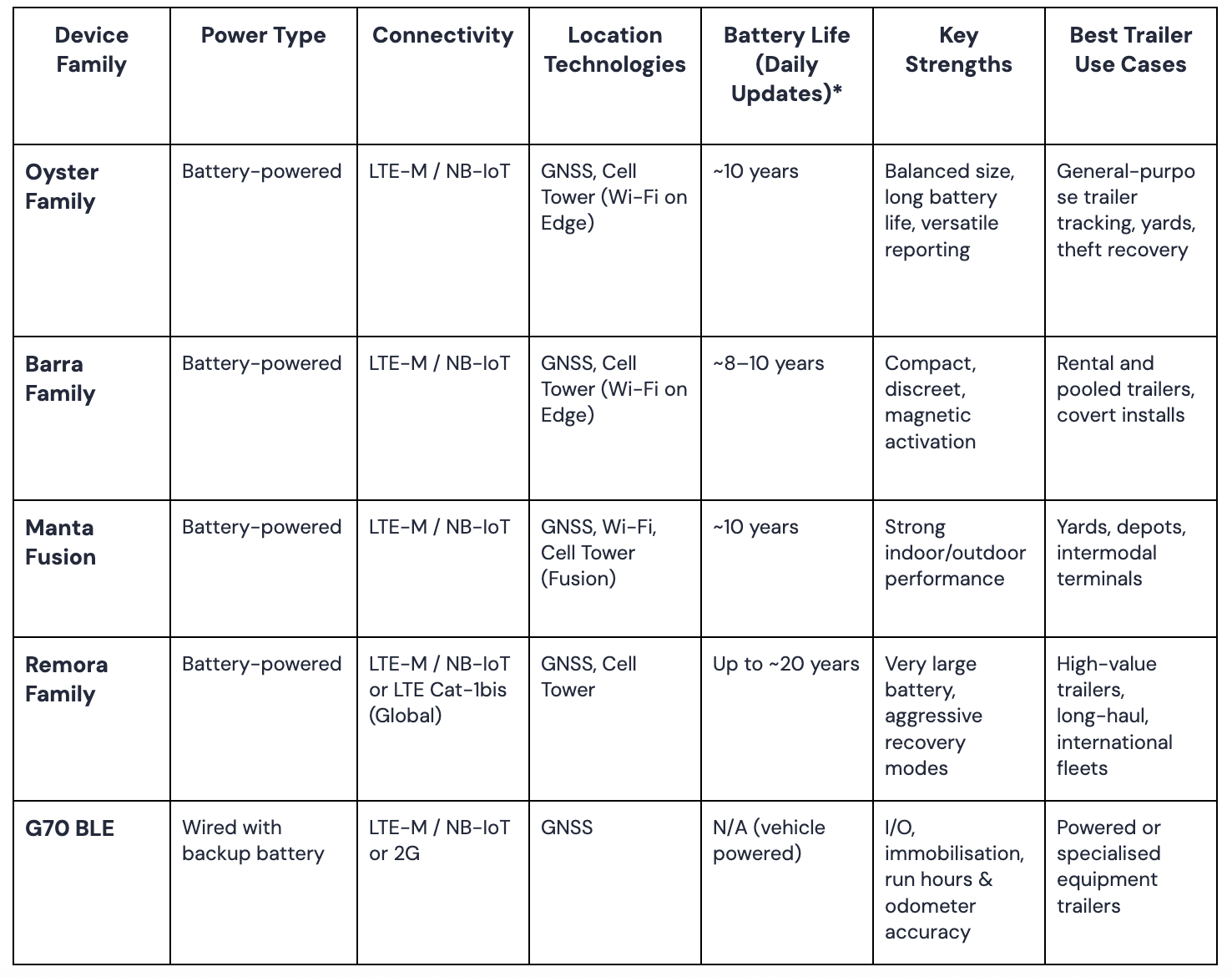
*Battery estimates depend on reporting configuration, movement frequency, network conditions, and sensor usage.
GPS Trailer Tracking Reporting Behavior Explained
What Location Reporting Really Means
Trailer systems rarely deliver continuous real-time tracking. Instead, they rely on movement-triggered reporting combined with scheduled health updates.
Common Reporting Mistakes
One of the biggest issues we see in GPS trailer tracking deployments isn’t hardware failure; it’s configuration misalignment. Trailers behave very differently from powered fleet vehicles, yet they’re often set up the same way.
A few common mistakes include:
- Excessive pings during long dwell periods
Trailers can sit stationary for days or weeks. Constant reporting during these periods drains battery life and clutters dashboards with unnecessary data. - Treating trailers like powered assets
Unlike trucks, trailers don’t have ignition states or continuous power. Applying vehicle-style tracking logic creates unrealistic expectations and shortens device lifespan.
These behaviors reduce battery performance, increase operational noise, and make it harder for teams to focus on meaningful movement events.
Aligning Reporting With Trailer Reality
To achieve long-term success, trailer tracking systems must reflect how trailers are actually used.
Well-designed systems prioritize:
- Long stationary periods
Reporting frequency should scale down intelligently when assets are idle. - Infrequent but meaningful movement
The system should detect genuine asset movement rather than constantly transmitting location data. - Exception-based real-time alerts rather than constant data flow
Alerts should trigger for unauthorized movement, geofence breaches, or yard exits, not routine inactivity.
When reporting aligns with real-world trailer behavior, you gain clarity instead of noise and battery life extends dramatically.
Why Many GPS Trailer Tracking Deployments Underperform
Underperformance rarely comes from bad intent. It usually stems from applying the wrong assumptions.
Common causes include:
- Expectations borrowed from vehicle tracking
Fleet managers often assume the same reporting cadence and logic should apply to unpowered trailers. - Selecting the wrong device for long-dwell use
Devices designed for powered assets or high-frequency tracking may not support multi-year battery life in trailer environments. - Platform defaults that override hardware behavior
Software settings can unintentionally increase reporting frequency, defeating battery-optimized hardware configurations.
Without a hardware-led system design, deployments can become expensive, maintenance-heavy, and operationally frustrating.
What a Reliable GPS Trailer Tracking System Looks Like
High-performing trailer tracking programs share a few consistent characteristics. They’re built around asset behavior, not borrowed fleet assumptions, and are designed to make it easy to start tracking without creating long-term maintenance headaches.
Successful deployments typically include:
- Hardware-led system design
The tracking device’s capabilities and battery profile guide reporting configuration, not the other way around. - Battery-powered devices with configurable behavior
The best GPS trackers boast adaptive reporting, movement-based triggers, and low-power sleep modes to extend service life. - Multiple location technologies for mixed environments
GPS, cellular triangulation, and optional Bluetooth® integration help maintain visibility in yards, depots, and remote areas. - Secure integration with partner platforms and APIs
Data flows into existing fleet, logistics, or ERP systems without adding manual steps.
This approach allows operators to deploy quickly while maintaining long-term flexibility, scalability, and performance, without constant battery replacements or unnecessary operational noise.
Common GPS Trailer Tracking Questions
If it only reports once a day, how do we recover a stolen trailer?
Daily updates are used during normal stationary periods to preserve battery life. When unexpected movement is detected, devices can automatically switch into recovery mode and increase reporting immediately. Upload schedules can also be aligned to higher-risk time windows, ensuring visibility when it matters most.
Is this too expensive for my fleet?
A variety of device options are available, each suited to different use cases and price points. At scale, the cost of devices and connectivity is often offset by reduced theft exposure, improved trailer utilization, and fewer manual site checks. Most fleets see value not just from tracking, but from the operational efficiency it enables across the asset lifecycle.
I do not know which device to use.
Device selection is usually straightforward after a short needs assessment. Trailer type, power availability, dwell behavior, and reporting expectations determine whether a compact, long-life, recovery-focused, or wired device is the right fit.
Can the tracker be concealed?
Yes. Devices can be installed underneath trailers, behind reflective markings, or within structural cavities while still maintaining reliable GPS and cellular performance. Covert placement reduces tampering risk without compromising data quality.
Effectively Applying GPS Trailer Tracking at Scale
When systems are designed around how trailers actually behave, GPS trailer tracking becomes a secure, scalable way to protect assets, improve visibility, and support long-term operational efficiency without unnecessary complexity.
To explore implementation options:
Visit the Trailer Tracking pillar page
Review the Trailer GPS Trackers device overview
Explore Trailer Tracking applications by industry
Contact Us Today
Get in touch with a Digital Matter representative from your region.